
Written for INDS 325: 2SLGBTQI+ Global Issues and Community Engagement (Royal Roads University), Assignment 4: Media Analysis. Submission format: blog post.
Introduction
In my autobiographical essay, I wrote about the first time I saw a same-sex love story on screen. A girl I was dating recommended Call Me by Your Name (Guadagnino, 2017). I was confused, I was uncomfortable, and I skipped scenes. For this analysis I went back and watched the whole film without skipping anything. This time I wanted to analyze it instead of just reacting to it.
The film is easy to call beautiful and easy to call problematic. Both are true, and neither is an analysis. Two course concepts run through this post. Heteronormativity is the set of cultural and social practices that lead people to believe and behave as if heterosexuality were the only possible sexuality (ILGA-Europe, 2014). Priming is the idea that exposure to media portrayals, including stereotypical ones, shapes the attitudes audiences carry toward real people (heinz, 2026; Miller & Lewallen, 2015). The first explains what the film pushes against. The second explains why a film like this matters, for better and for worse.
Context: Who Made It, for Whom, and Why
Call Me by Your Name was directed by Luca Guadagnino from a screenplay by James Ivory, adapted from André Aciman’s 2007 novel. It premiered at the Sundance Film Festival in January 2017 and was released by Sony Pictures Classics, a distributor of art-house and awards-season films. It was a low-budget independent production that became an awards success, and Ivory won the Academy Award for Best Adapted Screenplay. Its first audience was adult art-house viewers, critics, and awards voters, most of them straight and cisgender. It then found a second, much younger audience online, where the peach, the bicycles, and Elio’s shirts became memes and fan art.
The story is set in the summer of 1983 at a villa in northern Italy. Elio (Timothée Chalamet) is 17, the son of an archaeology professor. Oliver (Armie Hammer) is a 24-year-old American graduate student staying for six weeks. They fall in love. Oliver goes home. At Hanukkah he calls to say he is engaged to a woman, and the film ends on several minutes of Elio’s face in front of the fire.
The setting matters. The relationship is legal in the film’s world, since the age of consent in Italy is 14 (Bloomer, 2017). But 1983 was also the early period of the AIDS epidemic, and Italy gave same-sex couples no legal recognition until 2016. None of this appears on screen. The filmmakers chose a time and place where homophobia existed and then built a world in which it is never seen.

Audience and Different Interpretations
When I first watched the film, I read it as “a gay movie” and reacted to the label more than the story. Straight viewers like the person I was then are the audience the film is built for most carefully. Nothing explicit is shown. The camera pans to the window during the first sex scene. Both leads are conventionally masculine. As far as I noticed, nobody in the film ever says the word “gay.” It is easy to watch same-sex love here without feeling that the film is about being gay.
Many queer viewers read the film as affirming: a first love given the same seriousness as any straight romance, and a parent who responds with understanding. Other queer critics read it as a fantasy. Ratskoff (2018) called it “a sort of country house fairy tale in which the two leads just happen to be men” and argued that it leaves out gay community, politics, and culture. Ivory told The Guardian that Guadagnino’s choice was “to pan the camera out of the window toward some trees” rather than show the men’s bodies (as cited in Barfield, 2018).
A third reading focuses on the age gap. Some viewers found the relationship romantic; others found it predatory. Bloomer (2017) argued that depicting a relationship is not the same as endorsing it. I think both readings can be held at once: the film gives Elio the initiative in most scenes, but it still asks the audience to accept a power difference it never examines.
Reception also depends on where the viewer lives. López (2018, as cited in heinz, 2026) found that rural LGBTQ people in Catalonia did not feel represented by English-language television portrayals, which seemed unrealistic for their region. This film is set in rural Italy but made largely for an English-speaking audience; the town is a backdrop, and no local queer life is shown. Finally, the film has a life on social media that the filmmakers do not control. Are et al. (2024) found that LGBTQIA+ users go online to find role models, build networks, and try out new forms of self-expression, and that seeing LGBTQIA+ content helped some participants put words to parts of themselves. The film’s young fandom fits that pattern. The same study documents the risks, including harassment and being outed when content reaches the wrong audience.
Stereotypes and Tropes
The film avoids the stereotype that Miller and Lewallen (2015) tested: the feminine gay man. Elio and Oliver are both conventionally masculine. Oliver is tall, athletic, confident, and a little arrogant, with his casual “Later!” every time he leaves a room. There is no coming-out scene and no scene where anyone reacts with disgust.
But Miller and Lewallen’s (2015) findings complicate the idea that a non-stereotypical portrayal is automatically a good one. In their experiment with college students, “the mere presence of a gay male character, whether masculine or feminine, primed homonegative attitudes” (p. 358). The masculinity of Elio and Oliver does not guarantee a positive effect; it may simply make the film easier for straight viewers to sit through. That fits my experience. The portrayal was as non-stereotypical as it gets, and I still skipped scenes. The discomfort was not on the screen. It was in me, put there by years of earlier media.
The film does lean on tropes. The first is the summer romance that must end. The second is the “no labels” trope. Neither man is ever called gay or bisexual, and both are involved with women during the story. This can be read as erasure of bisexuality or as honesty about fluidity. Zhang (2024) reports a twelve-year study of about 35,000 people in Stockholm in which 15.7% of adults changed how they described their sexual identity. Not labelling the characters fits real lives, and it fits GLAAD’s (2022) advice to ask people what terms they use before assigning one. The problem is that nobody in the film names anything, so each viewer can fill in whatever is most comfortable.
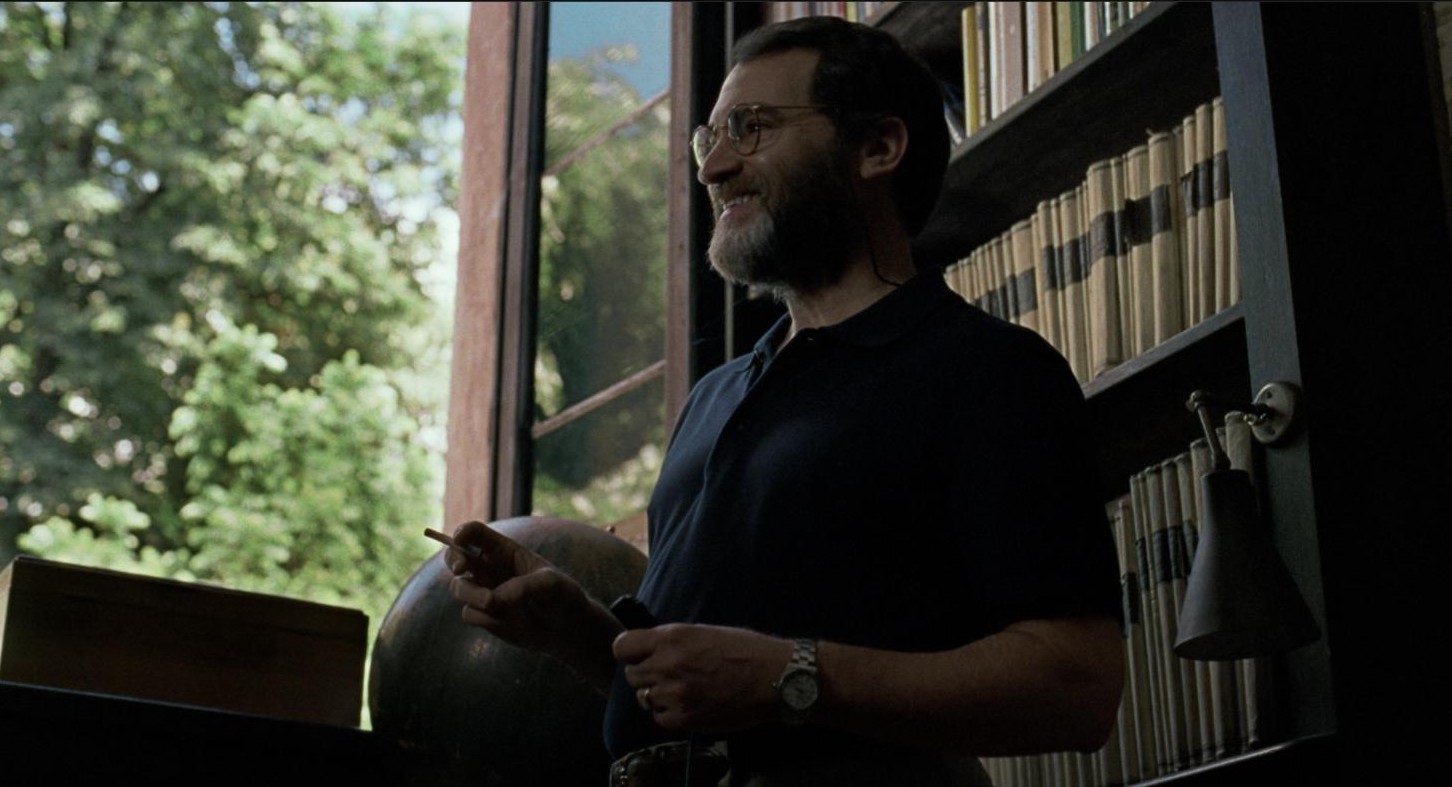
The third trope is the accepting parent. Mr. Perlman’s speech near the end is the scene people quote most. It could have been wish fulfilment, but it works because it is specific: he talks about his own regrets and tells Elio not to kill what he feels. The fourth is the heartbreak ending. Nobody dies, so this is not the “bury your gays” pattern, but the relationship still ends with one man choosing a heterosexual marriage. Oliver’s explanation is the film’s only direct mention of homophobia: “My father would have carted me off to a correctional facility” (Guadagnino, 2017). That one line admits the outside world is not safe. The film simply keeps that world off screen.
Dominant Narratives
Four stories dominate the film. First, desire is natural and first love is formative. Mr. Perlman says that “nature has cunning ways of finding our weakest spot” (Guadagnino, 2017), and Elio’s longing is treated as something to respect, not correct. Second, love is universal: viewers see a love story first and a gay story second, which is a strength for reaching straight audiences and the exact weakness Ratskoff (2018) describes.
Third, acceptance comes from educated, liberal, wealthy families. The Perlmans speak three languages at dinner, read a sixteenth-century romance aloud, and pull Greek statues out of a lake. Their acceptance is tied to class and culture, and the film never imagines it anywhere else. Fourth, love is private. Elio tells Oliver that his mother calls the family “Jews of discretion” (Guadagnino, 2017), quiet about their Jewishness in Catholic Italy, while Oliver wears his Star of David openly. Over the summer Elio begins wearing his. This is the film’s clearest metaphor for the closet and for coming out, which ILGA-Europe (2014) defines as the process of revealing one’s identity. It is also a small lesson in intersectionality: Elio learns to carry one minority identity by watching Oliver carry another.

Absent Narratives
A critical analysis has to look at what is missing. Homophobia, violence, and the law are absent, apart from Oliver’s one line. HIV and AIDS are absent, even though the story is set in 1983, which for gay men of that generation is an enormous silence. Queer community is absent: no other gay characters, no bar, no friend, no older person who has lived this before. Elio and Oliver have nobody to talk to except each other and, at the very end, Elio’s father.
Class and race are absent in a different way. Everyone who matters is white, wealthy, and educated; the housekeeper and groundskeeper serve meals and tend the property, and people of colour do not exist in this Italy. Women are present but instrumental: Marzia and Chiara prove that the men are desirable to women and are then set aside, and Marzia’s offer to be friends for life lets Elio off the hook. Trans, non-binary, Two-Spirit, and disabled people are not present at all. And Oliver’s inner life is absent. We see everything through Elio, so Oliver’s fear, his family, and his decision to marry are never explored. The film is about the boy who gets to feel. The man who has to decide is left blank.
Language, Images, Sound, and Metaphors
The film’s language is indirect on purpose. The title line, “call me by your name and I’ll call you by mine” (Guadagnino, 2017), turns love into an exchange of identities rather than a label. “Is it better to speak or to die?” comes from the old romance Elio’s mother reads aloud, and it becomes Elio’s question about whether to confess. This is the language of hints, which is what a closeted courtship sounds like, but it also means the film never has to say anything plainly.
The images work the same way. Sunlight, water, fruit, and bare skin make the film sensual without being explicit. Mr. Perlman’s slides of Greek and Roman bronzes, which he describes as daring the viewer to desire them (Guadagnino, 2017), give same-sex desire a long, respectable history; the film borrows the authority of classical art. The pan to the window is the most debated image in the film, and Ivory’s objection shows the restraint was a choice. Then there is the final shot: for several minutes the camera holds on Elio’s face by the fire while dinner is prepared behind him. After two hours of hints, the film finally refuses to cut away.
Sound gives the audience its emotional instructions. Sufjan Stevens’s “Mystery of Love” and “Visions of Gideon” are soft and wistful; they tell us this is tender, not scandalous. The best metaphor in the film is at the piano. Elio plays a piece by Bach for Oliver, then plays it the way he says Liszt would have, then the way Busoni would have, before finally playing it as Bach wrote it (Guadagnino, 2017). The melody stays the same while its expression changes. That is as good a description of sexual identity as anything in the readings, and it matches Zhang’s (2024) point that identity can stay yours while the way you describe it shifts.

Underlying Assumptions and Values
The film assumes that same-sex love deserves the same beauty and seriousness as straight love, which is a direct challenge to heteronormativity. But it also assumes that queer love is most acceptable when it is beautiful, cultured, masculine, private, and temporary. It assumes acceptance flows from liberal, educated parents and never imagines it in a religious or working-class family. And it values feeling over politics. Mr. Perlman tells Elio not to kill his pain, and the film treats that private advice as enough. For the Perlmans in their villa, maybe it was. For most people in 1983, it was not.
Applied and Ethical Implications
The first implication is about attitudes. Films like this can move people; this one eventually moved me. But Miller and Lewallen (2015) show that exposure to a gay character can also prime negative attitudes in some viewers, however the character is portrayed. There is no guaranteed positive representation, and anyone who makes or promotes media should not assume visibility alone does the work.
The second is about my own field. In marketing and design, 2SLGBTQIA+ representation is a live decision, and the numbers show it is contested. Across 26 countries, only 29% of people support more LGBT characters on television, in films, and in advertising; in Canada the figure is 37%; and support for companies actively promoting equality for LGBT people fell from 49% in 2021 to 41% in 2025 (Ipsos, 2025). The ethical question for an agency is whether we show queer people only when it is safe and pretty, which is the Call Me by Your Name template, or also when it is specific and uncomfortable.
The third is about families. Rana et al. (2024), in interviews with South Asian gay and bisexual young men in Canada, found that parents were very concerned about what others would think, that the most common reactions were anger, denial, and avoidance, and that resources for South Asian sexual minority youth are lacking; they call for culturally relevant interventions to increase parental support. Mr. Perlman is a model of acceptance, but he is a secular, wealthy, European academic in an English-language prestige film. A South Asian parent, including parents in my own community, may not see themselves in him at all. The film can start a conversation in a family. It cannot finish one.
The fourth is about the age gap and about omission. The relationship is legal where the story is set (Bloomer, 2017), and the film gives Elio agency, but it still normalizes an adult-teenager relationship without examining the power difference. In the same way, leaving out AIDS and homophobia lets the film be a refuge, which many queer viewers value, but it hands a younger audience a version of 1983 that did not exist for most gay men. Finally, Are et al. (2024) show that social media gives LGBTQIA+ users role models and safety in numbers, and also exposes them to harassment and unwanted disclosure. For a young person using this film to explore who they are online, the features that support them are the same ones that can put them at risk.
Conclusion
The first time I watched Call Me by Your Name, I thought it was about two men, and I looked away. This time I think it is about what a mainstream audience is willing to look at. The film expanded what that audience will accept: a same-sex love story told with the same seriousness as any other. At the same time it narrowed what counts as acceptable, because the love it shows is white, wealthy, masculine, private, and over by September. Both things are true. The film is a door a lot of people walked through, including me. The course readings are a reminder that the room on the other side is much bigger, and much less comfortable, than the villa.

References
Are, C., Talbot, C., & Briggs, P. (2024). Social media affordances of LGBTQIA+ expression and community formation. Convergence: The International Journal of Research into New Media Technologies, 31(4), 1401–1422. https://doi.org/10.1177/13548565241296628
Barfield, C. (2018, March 28). ‘Call Me By Your Name’ writer James Ivory says lack of nudity ‘feels phony.’ The Playlist. https://theplaylist.net/james-ivory-nudity-call-me-by-your-name-20180328/
Bloomer, J. (2017, November 8). What should we make of Call Me by Your Name‘s age-gap relationship? Slate. https://slate.com/human-interest/2017/11/the-ethics-of-call-me-by-your-names-age-gap-sexual-relationship-explored.html
GLAAD. (2022). GLAAD media reference guide (11th ed.). https://glaad.org/reference/
Guadagnino, L. (Director). (2017). Call me by your name [Film]. Frenesy Film Company; La Cinéfacture; RT Features; Sony Pictures Classics.
heinz, m. (2026). Week 4 notes & study guide [Course notes]. INDS 325: 2SLGBTQI+ Global Issues and Community Engagement, Royal Roads University. https://moodle.royalroads.ca/moodle/mod/page/view.php?id=869940
ILGA-Europe. (2014). ILGA-Europe glossary. https://ilga-europe.org/sites/default/files/ilga-europe_glossary_final_170714_www.pdf
Ipsos. (2025, June). Ipsos LGBT+ Pride report 2025: A 26-country Ipsos Global Advisor survey. https://www.ipsos.com/sites/default/files/ct/news/documents/2025-06/ipsos-pride-report-2025.pdf
Miller, B., & Lewallen, J. (2015). The effects of portrayals of gay men on homonegativity and the attribution of gender-based descriptors. Communication Studies, 66(3), 358–377. https://doi.org/10.1080/10510974.2015.1018446
Rana, M., Nath, R., & Saewyc, E. (2024). Parental accepting and rejecting behaviors: Experiences of South Asian gay and bisexual men in Canada. Family Relations, 73(2), 1014–1026. https://doi.org/10.1111/fare.12924
Ratskoff, B. (2018, January 5). ‘Call Me by Your Name’: Gorgeous, but is it gay? The Advocate. https://www.advocate.com/commentary/2018/1/05/call-me-your-name-gorgeous-it-gay
Zhang, W. (2024, December 24). Sexual identity is more fluid than previously thought, says twelve-year study. The Conversation. https://theconversation.com/sexual-identity-is-more-fluid-than-previously-thought-says-twelve-year-study-243892


Leave a Reply