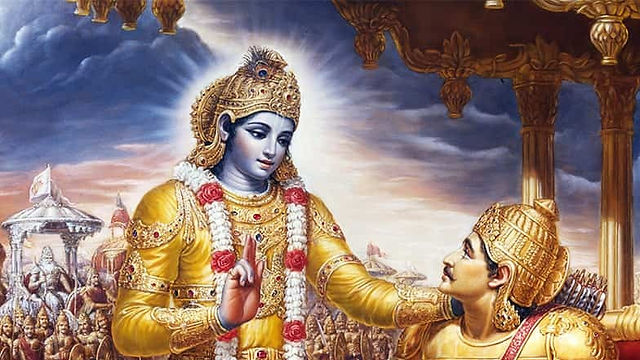
The Bhagavad Gita, often referred to simply as the Gita, is a dialogue between Prince Arjuna and his charioteer Lord Krishna, who imparts spiritual wisdom and guidance on the battlefield of Kurukshetra. It has been subject to numerous translations and commentaries, reflecting a wide range of philosophical interpretations. Among these, “Bhagavad-gita As It Is” by A.C. Bhaktivedanta Swami Prabhupada, the founder of the International Society for Krishna Consciousness (ISKCON), stands out for its global influence and distinctive perspective, I have spent the last month reading and interpreting this version of the holy book.
Diverging Interpretations
Prabhupada’s commentary emphasizes bhakti (devotion) to Krishna, aligning with his Gaudiya Vaishnavism beliefs. This devotional lens is both the strength and the point of contention for readers seeking philosophical diversity within the Gita’s interpretations. For instance, the verse 2.47 in the Gita, often translated as, “Your right is to work only, but never to its fruits. Let not the fruits of action be your motive, nor let your attachment be to inaction,” is seen by Prabhupada as an instruction for acting in Krishna’s service without attachment to outcomes, a viewpoint highlighting the path of devotional service.
In contrast, philosophers like Ashtavakra interpret this verse differently, focusing on the nature of the self and detachment from not just the fruits, but also the act itself, emphasizing a non-dualistic understanding of the self and the universe. Ashtavakra’s teachings, primarily found in the Ashtavakra Gita, advocate for a realization of the self’s true nature as unchanging and beyond the physical world, a stark contrast to the active engagement and devotion emphasized by Prabhupada.
ISKCON’s teachings, emphasize the importance of following one’s prescribed duties according to their position in society, which appears to reinforce traditional caste roles. This perspective suggests that social order and spiritual progress are interconnected, with each individual’s dharma being tied to their social duties.
However, concept of dharma in the Gita focuses on the universal and individual aspects of duty that transcend social and caste distinctions. Krishna’s teachings aim to guide individuals toward their true nature and the performance of duty without attachment to the results, which is a state of being that can lead to spiritual liberation (moksha).
Krishna’s dialogue with Arjuna is centered on the concept of svadharma, or one’s own duty, which is not strictly defined by social order but by one’s innate qualities and the inner call to righteousness. This interpretation suggests that dharma is dynamic and personal, reflecting a universal principle of order and righteousness that each person must discover and follow in the context of their own life and circumstances.
Consider Prabhupada’s interpretation of 9.26: “If one offers Me with love and devotion a leaf, a flower, fruit or water, I will accept it.” Prabhupada emphasizes the simplicity of devotion and the accessibility of divine service to all, irrespective of material wealth or status. This interpretation fosters a personal and emotional connection to the divine, aligning with bhakti yoga.
However, a non-dualistic philosopher like Adi Shankaracharya focus on the underlying unity of the atman (soul) and Brahman (universal soul), interpreting the act of offering not as a physical transaction but as a symbolic representation of the dissolution of ego and realization of oneness with the divine.
ISKCON’s Gita has a perceived rigidity in interpretation, particularly the emphasis on devotional service (bhakti) as the supreme path, potentially overlooking the Gita’s acknowledgment of other paths such as jnana (knowledge) and karma (action) yoga as equally valid avenues for spiritual attainment.
While the Gita’s teachings are universal, focusing on the inner journey towards enlightenment and the nature of reality, ISKON’s interpretations presents them within a more sectarian framework, emphasizing adherence to specific religious practices or the worship of a particular deity as the only path to salvation.
Balancing Perspectives
The challenge with ISKCON’s Gita lies not in inaccuracies but in its singular focus on bhakti to the exclusion of other paths that the Gita itself presents: karma (action), jnana (knowledge), and dhyana (meditation). The Gita is a complex text that accommodates a multitude of spiritual paths, recognizing the diversity in human nature and spiritual inclinations.
Scholars like Sarvepalli Radhakrishnan have emphasized the Gita’s philosophical depth and its synthesis of different paths to spiritual realization. According to Radhakrishnan, the Gita’s essence lies in its call for action grounded in wisdom and detachment, a universal message that transcends religious and cultural boundaries.
Conclusion
The Gita, with its multifaceted teachings, invites readers to explore a spectrum of spiritual paths. While Prabhupada’s “Bhagavad-gita As It Is” offers profound insights into bhakti yoga, it is one among many windows to the Gita’s vast philosophical landscape. Engaging with diverse commentaries, including those by Ashtavakra, Adi Shankaracharya, and modern philosophers, can enrich our understanding and appreciation of this ancient text, reminding us of the Gita’s enduring relevance in addressing the fundamental questions of duty, morality, and the nature of reality.
Shubham Rattan
 the Roots
Leave a comment