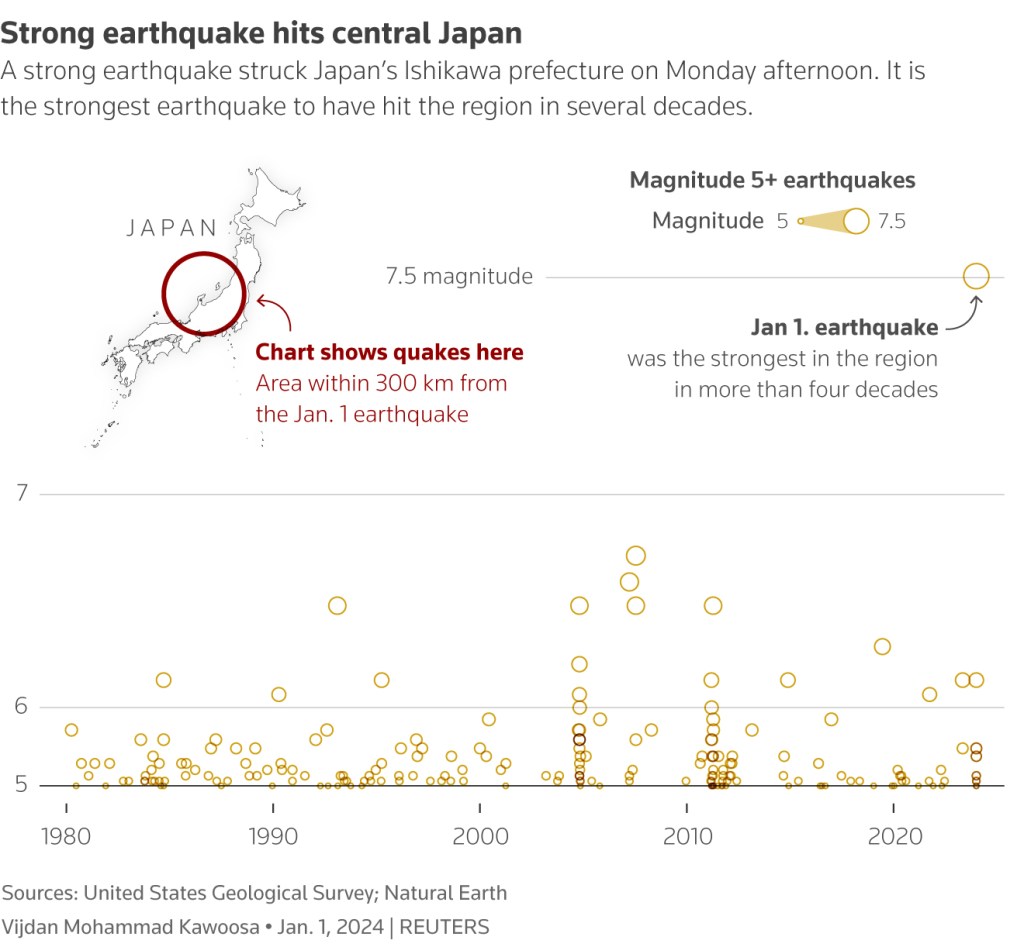
On January 1, 2024, the Noto Peninsula in Ishikawa Prefecture, Japan, was struck by a significant seismic event, registering a magnitude of 7.6. This event is noteworthy both for its magnitude and the resultant geophysical phenomena, including a major tsunami warning and widespread structural impacts.

This initial quake was quickly followed by a more powerful 7.6 magnitude earthquake, and subsequently, a series of smaller tremors were recorded, including magnitudes of 6.1, 4.5, 4.6, and 4.8 within the span of about half an hour.
Approximately an hour after these seismic events, the first tsunami waves, measuring around 4 feet in height, reached the Wajima port in Ishikawa prefecture. Although the initial tsunami warning anticipated waves up to 16 feet, it was later revised to a lower-level warning, with expectations of waves reaching up to 10 feet. Amid these warnings, residents were advised against returning home and to evacuate immediately for their safety.
The government’s spokesperson, Yoshimasa Hayashi, emphasized the urgency of the situation, particularly for those in coastal regions, urging immediate evacuation to avoid the imminent tsunami threat.
Japan, located on the Pacific “Ring of Fire”, is no stranger to seismic activities. The Noto Peninsula, in particular, has a history of geological unrest, underlined by its complex tectonic setting. This recent earthquake presents an opportunity to examine the dynamics of seismic activity in this region.
Seismicity and Tectonic Setting:
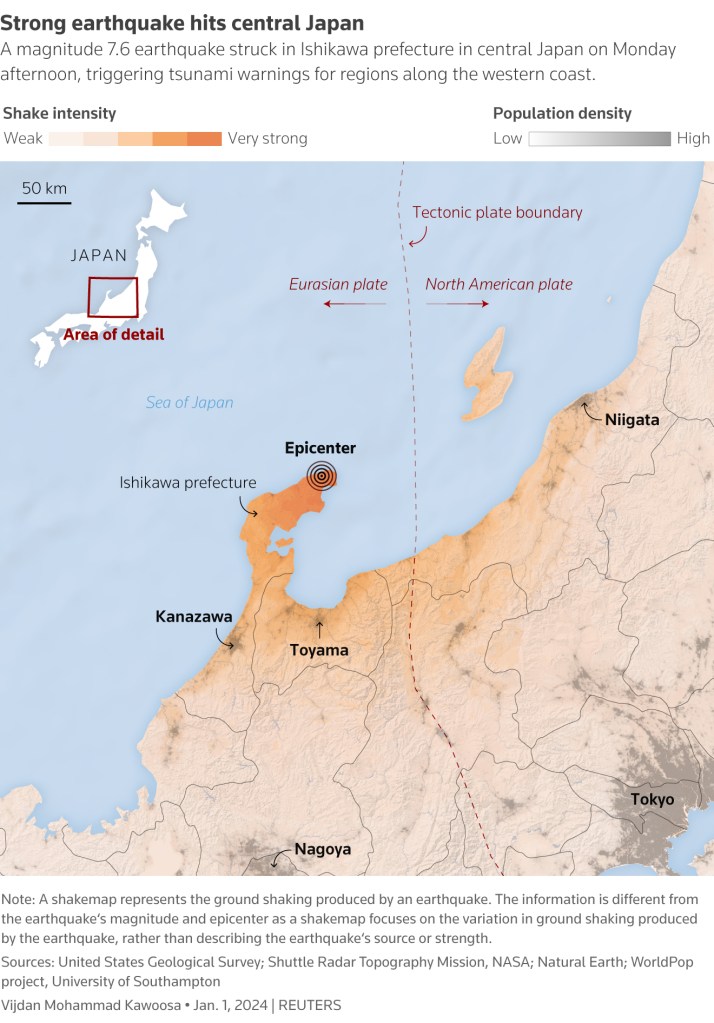
The earthquake occurred with a shallow hypocenter, characteristic of crustal earthquakes in the region. The Noto Peninsula lies at the confluence of several tectonic plates, including the Eurasian, North American, and Philippine Sea plates. This multi-plate intersection creates significant crustal stresses, resulting in frequent seismic activities.
The earthquake’s magnitude and intensity, peaking at Shindo 7 on the Japanese scale, indicate substantial energy release. This intensity level, the highest in the Japanese seismic intensity scale, suggests severe ground shaking with potential for considerable damage.
Tsunami Genesis and Coastal Impact:
Following the earthquake, a major tsunami warning was issued, with potential waves up to 5 meters high. Tsunamis, typically triggered by undersea earthquakes, are not uncommon in this region, given the seabed topography and tectonic activity. The subsequent downgrade of the tsunami warning and the absence of significant wave impact highlight the challenges in predicting tsunami behavior following seismic events.
Structural and Societal Impacts:
The earthquake led to power outages, infrastructure damage, and evacuation orders, affecting thousands of residents. Understanding the structural response to such seismic events is crucial for future urban planning and disaster mitigation strategies in seismically active regions.
Shubham Rattan
 the Roots
Leave a comment